/*************************************************************************
 *  Compilation:  javac Sierpinski.java
 *  Execution:    java Sierpinski
 *
 *  @author: Karen Li
 *
 *************************************************************************/

public class Sierpinski {

    // Height of an equilateral triangle whose sides are of the specified length.
    public static double height(double length) {
        double a = (length * Math.sqrt(3.0))/2.0;
        return a;
    }

    // Draws a filled equilateral triangle whose bottom vertex is (x, y)
    // of the specified side length.
    public static void filledTriangle(double x, double y, double length) {
        double a = height(length);
        StdDraw.filledPolygon(new double[] {x, x - (length/2.0), x + (length/2.0)}, new double[] {y, y + a, y + a});
    }

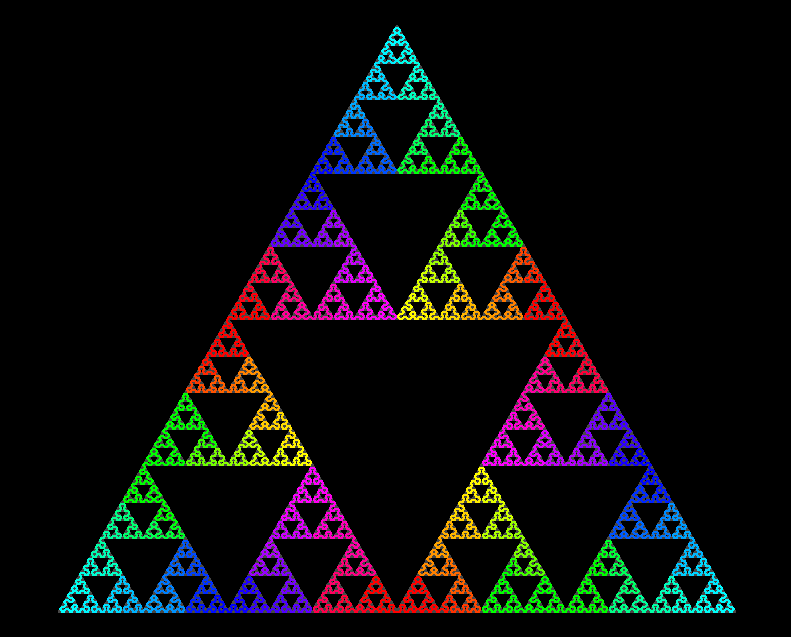
    // Draws a Sierpinski triangle of order n, such that the largest filled
    // triangle has bottom vertex (x, y) and sides of the specified length.
    public static void sierpinski(int n, double x, double y, double length) {
        if (n > 0){
            filledTriangle(x, y, length);
            sierpinski(n - 1, x, y + height(length), length/2);
            sierpinski(n - 1, x - (length/2.0), y, length/2);
            sierpinski(n - 1, x + (length/2.0), y, length/2);
        }
    }

    // Takes an integer command-line argument n;
    // draws the outline of an equilateral triangle (pointed upwards) of length 1;
    // whose bottom-left vertex is (0, 0) and bottom-right vertex is (1, 0); and
    // draws a Sierpinski triangle of order n that fits snugly inside the outline.
    public static void main(String[] args) {
        int n = Integer.parseInt(args[0]);
        double length = 1;
        double a = height(length);
        StdDraw.polygon(new double[] {0, length/2, length}, new double[] {0, a, 0});
        sierpinski(n, length/2, 0, length/2);
    }
}


 Karen Li